


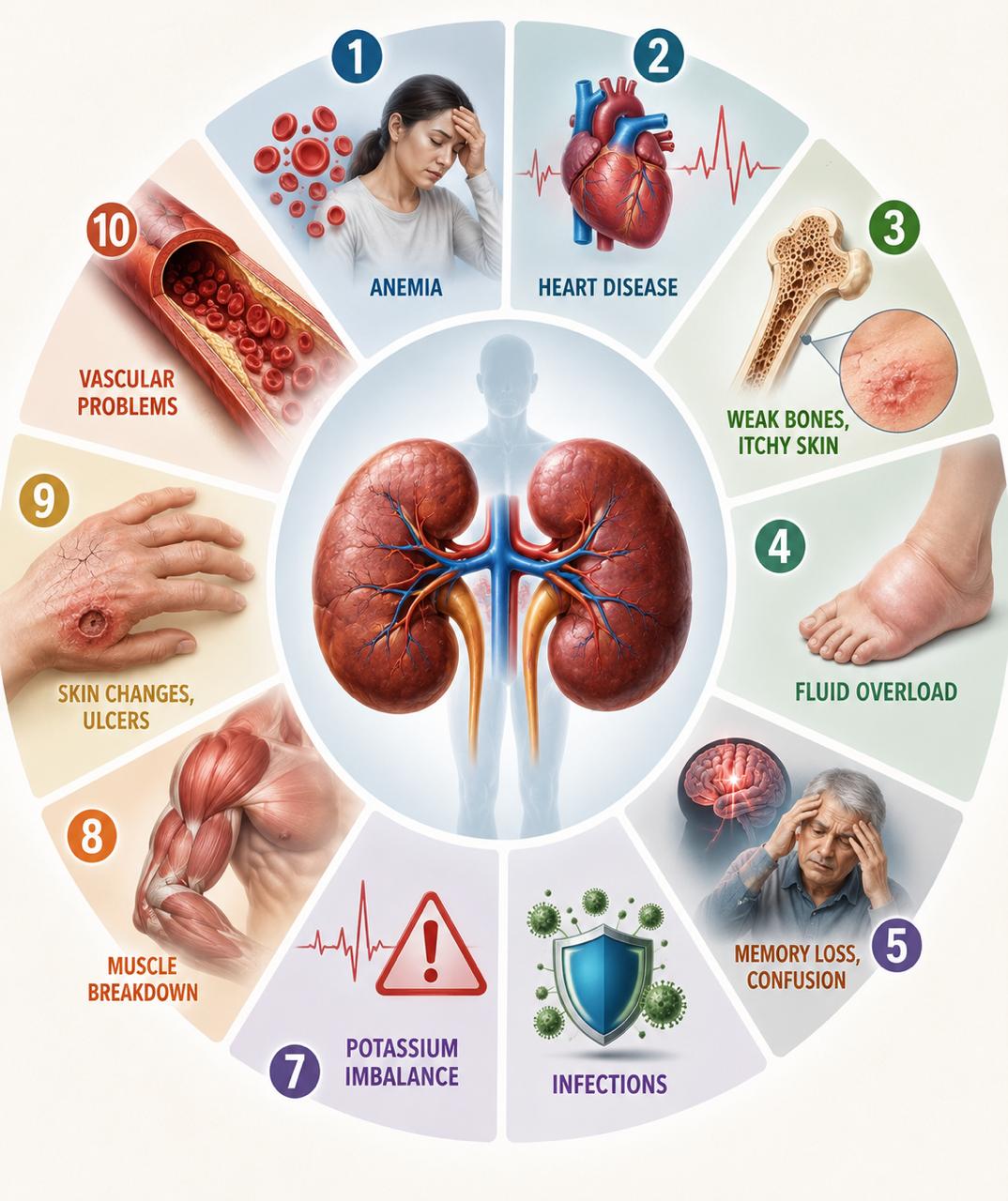
Most people think kidney disease affects only the kidneys.
It doesn’t.
Your kidneys work silently every minute of every day. They clean your blood, control blood pressure, balance minerals, make hormones, protect your bones, and keep every organ working in harmony.
So when the kidneys begin to fail, the entire body feels the consequences.
Ten ways kidney disease can affect the body
Here are ten ways kidney disease can affect you.
Anemia – The Tiredness That Never Leaves
Anemia – The Tiredness That Never Leaves
Healthy kidneys produce a hormone that helps your body make red blood cells.
When this hormone falls, so does your blood count.
You may feel constantly tired, breathless, dizzy, cold, and unable to do even simple daily activities.
Heart Disease – The Biggest Threat
Heart Disease – The Biggest Threat
The heart and kidneys are best friends.
When one suffers, the other often follows.
High blood pressure, excess fluid, anemia, and damaged blood vessels increase the risk of heart attacks, heart failure, irregular heartbeats, and stroke.
In fact, many patients with kidney disease die from heart disease rather than kidney failure itself.
Weak Bones and Relentless Itching
Weak Bones and Relentless Itching
Failing kidneys cannot maintain the right balance of calcium, phosphorus, and vitamin D.
The result?
Bones become weak and painful.
Skin becomes intensely itchy—often worst at night.
Over time, calcium may even deposit in blood vessels and soft tissues.
Fluid Overload – When Water Has Nowhere to Go
Fluid Overload – When Water Has Nowhere to Go
Healthy kidneys remove excess water.
Damaged kidneys cannot.
Fluid builds up in the legs, face, and lungs.
Patients develop swelling, breathlessness, uncontrolled blood pressure, and sometimes life-threatening heart failure.
Memory Loss and Confusion
Memory Loss and Confusion
As waste products accumulate in the blood, they begin to affect the brain.
Patients may notice poor concentration, forgetfulness, disturbed sleep, irritability, and confusion.
In severe cases, kidney failure can lead to seizures or even coma.
Frequent Infections
Frequent Infections
Kidney disease weakens the body’s immune system.
Patients become more vulnerable to urinary infections, chest infections, skin infections, dialysis access infections, and slow wound healing.
Even a small infection can become serious if ignored.
High Potassium – The Silent Emergency
High Potassium – The Silent Emergency
Potassium is essential—but too much can be deadly.
Kidneys normally remove excess potassium.
When they fail, potassium levels can rise silently.
Sometimes there are no warning signs until an abnormal heartbeat—or even sudden cardiac arrest—occurs.
Muscle Loss and Painful Cramps
Muscle Loss and Painful Cramps
Kidney disease slowly steals muscle strength.
Patients lose muscle mass, feel weak, tire easily, and struggle with daily activities.
Painful night-time muscle cramps and twitching are also common in advanced kidney disease.
Skin Changes and Poor Wound Healing
Skin Changes and Poor Wound Healing
The skin often tells the story before the kidneys do.
Dryness.
Persistent itching.
Darkening of the skin.
Easy bruising.
Slow-healing wounds.
Even a small cut may become a chronic ulcer if not treated properly.
Blood Vessel Damage – From Head to Toe
Blood Vessel Damage – From Head to Toe
Kidney disease silently damages blood vessels throughout the body.
The arteries become stiff and calcified.
Blood flow to the heart, brain, hands, and feet decreases.
This can lead to strokes, poor circulation, painful walking, non-healing foot ulcers, and difficulties creating dialysis access.
The Good News
The Good News
None of these complications are inevitable.
Many can be prevented—or significantly delayed—with early diagnosis, good blood pressure and diabetes control, a kidney-friendly diet, regular follow-up, appropriate medications, and avoiding harmful drugs like unnecessary painkillers.
Remember…
Kidney disease is never just a kidney disease.
It is a whole-body condition.
The earlier we protect the kidneys, the more we protect the heart, brain, bones, muscles, blood vessels, and ultimately… life itself
More Blogs

23 August, 2026
Which Chicken Is Better for Kidney Patients?
Many patients ask me, “Doctor, can I eat chicken if I have kidney disease?” The answer is yes—but choose the right part and the right…

23 August, 2026
Can Children Get Kidney Disease Too?
The answer is yes. And that’s exactly why parents need to know the warning signs. Most people think kidney disease is a problem of old…