


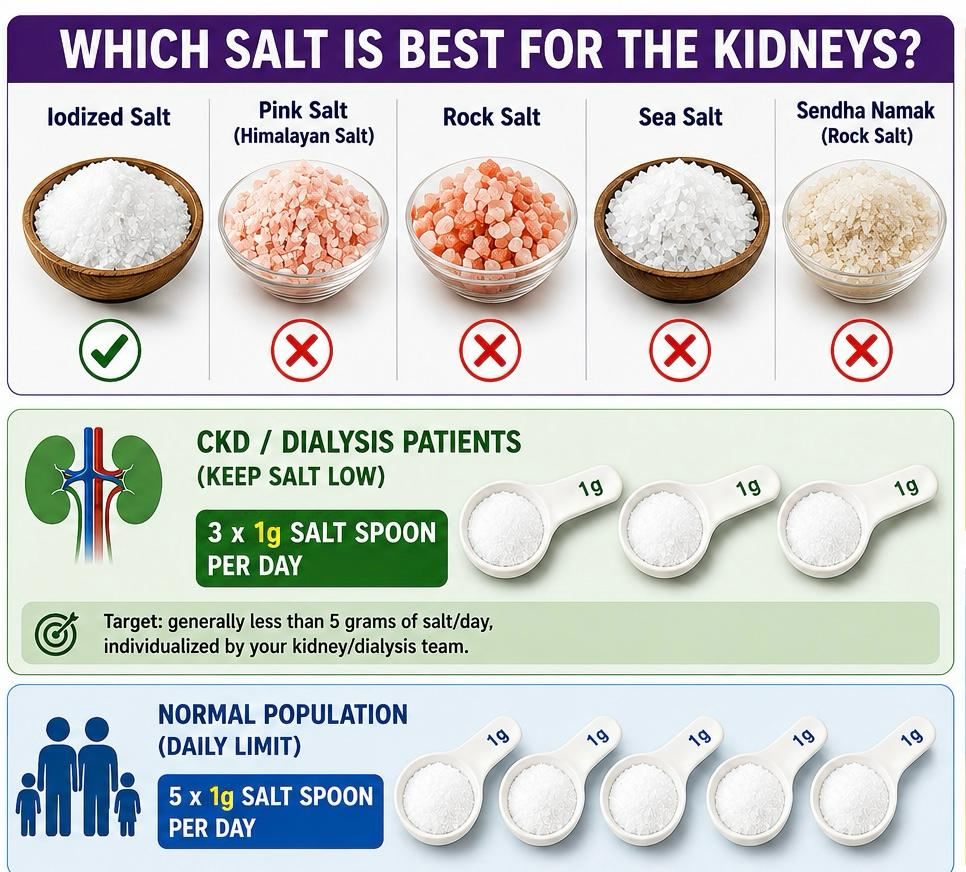
The most important thing is HOW MUCH salt you eat — not whether the salt is white, pink, Himalayan, sea salt or rock salt.
Which salt is best for the kidneys?
Regular iodized salt is usually the simplest choice.
The key message:
CHANGE THE QUANTITY, NOT THE COLOUR!
WHAT ABOUT TATA SALT LITE / LOW-SODIUM SALT?
Kidney patients should NOT automatically switch to low-sodium or “lite” salts.
Many low-sodium salts replace some sodium chloride with potassium chloride.
What about potassium-based salt substitutes?
For some people this can be useful, but in CKD and dialysis, potassium can accumulate in the blood and become dangerous.
So if you have kidney disease:
Do not use potassium-containing salt substitutes unless your kidney doctor or dietitian says they are safe for you.
Always check the packet for “potassium chloride” or “KCl.”
IS HIMALAYAN / PINK SALT HEALTHIER?
Pink salt, Himalayan salt, rock salt and sea salt are often marketed as healthier alternatives.
But remember:
The key message
They still contain plenty of sodium.
The small amounts of other minerals they contain do not make them kidney-protective.
Pink salt is not a treatment for BP.
Himalayan salt does not protect the kidneys.
Sea salt is not “sodium-free.”
For your kidneys, the quantity matters much more than the colour or price of the salt
More Blogs

23 August, 2026
Dialysis or Kidney Transplant—Which Should I Choose?
When someone reaches kidney failure, one question changes everything: “Should I start dialysis… or should I get a kidney transplant?” The answer isn’t the same…

23 August, 2026
The 5 Stages of Kidney Disease
A Silent Journey… That Can Be Changed Chronic Kidney Disease (CKD) doesn’t develop overnight. The 5 Stages of Kidney Disease It usually progresses slowly over…